

Write in Your Journal Like Anaïs Nin: 4 New Approaches to Try
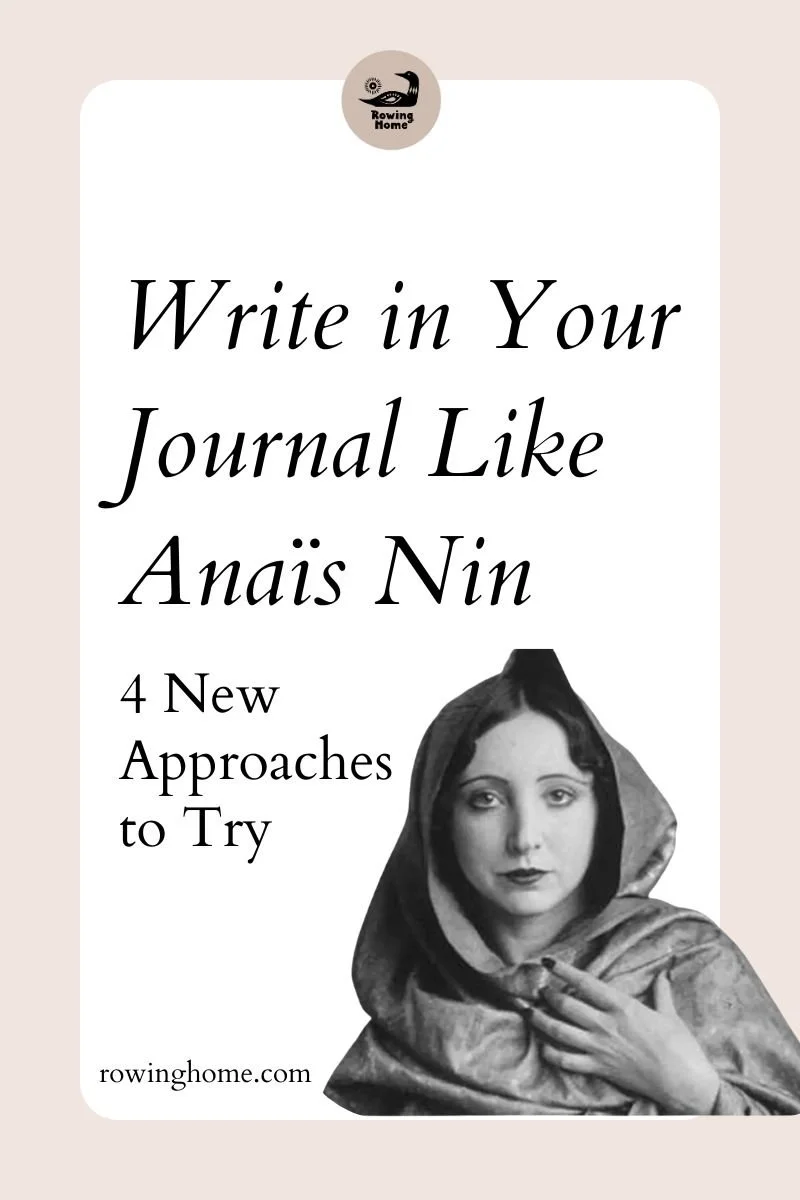
What started as a letter from an 11-year-old girl to her absent father became a lifelong project of self-discovery. Anaïs Nin’s extensive diaries were an attempt to capture the world in such a way that they would persuade her father to return. She continued The Diaries for her entire life as a prolific chronicle of her complex relationships, her innermost thoughts and experiences, and a study of her unique and fluid novelistic style.
For decades, Anaïs Nin’s diaries were private, allowing space to explore herself uncensored (though she shared her diaries occasionally with trusted friends). She began revising and publishing The Diaries in 1966. There are now seven published volumes that span her lifetime, and four volumes of early diaries that were published after her death.
In The Diaries, inner and outer worlds blurred. Anaïs wanted to know herself, placing an emphasis on her internal landscape and an intimate excavation of the soul. Her style is a celebration of beauty, free association, emotion, and spontaneity.
Bring the techniques of Anaïs into your practice to develop an intimate connection with the self:
1. Make “Word Portraits”
2. Ask Questions
3. Obey the Impulse
4. Write about Writing
1. Make “Word Portraits”
Relationships shape our existence. Encounters with others are defining. Composing “word portraits” reveals as much about ourselves as the people we’re describing–what we observe about others, how they impact us, how we change through mutual impact on one another, and our unfolding stories.
Anaïs wrote vivid portraits of the people she encountered throughout her life, placing emphasis on capturing their secret, inner selves, feelings which often evade description. She did not shy away from her subjective experience of a person, but described it openly.
On December 30, 1931, when she was getting to know June Miller (the wife of author Henry Miller), Anaïs wrote:
June does not accept a gift which has no symbolic significance. June washes laundry to be able to buy herself a bit of perfume. June is not afraid of poverty and drabness, is untouched by it, is untouched by the drunkenness of her friends (her drunkenness is so different, it's more like exaltation)...When June tells her endless anecdotes now, I understand they are ways of escape, disguises for a self which lives secretly behind that smoke-screen talk. I think so much about her, all day, all night. As soon as I left her yesterday, there was a painful void, and I shivered with cold. I love her extravagances, her humility, her fears of disillusion. (The Diary of Anais Nin, Vol. 1: 1931-1934, p. 33)
Anaïs rejected realism and its brutal depictions that painted everyone in an unflattering light. She aimed to capture others “compassionately”–a word that means “with passion.” In February 1932, Anaïs wrote:
Compassion is the only key I ever found which fits everyone. (V1, p. 52).
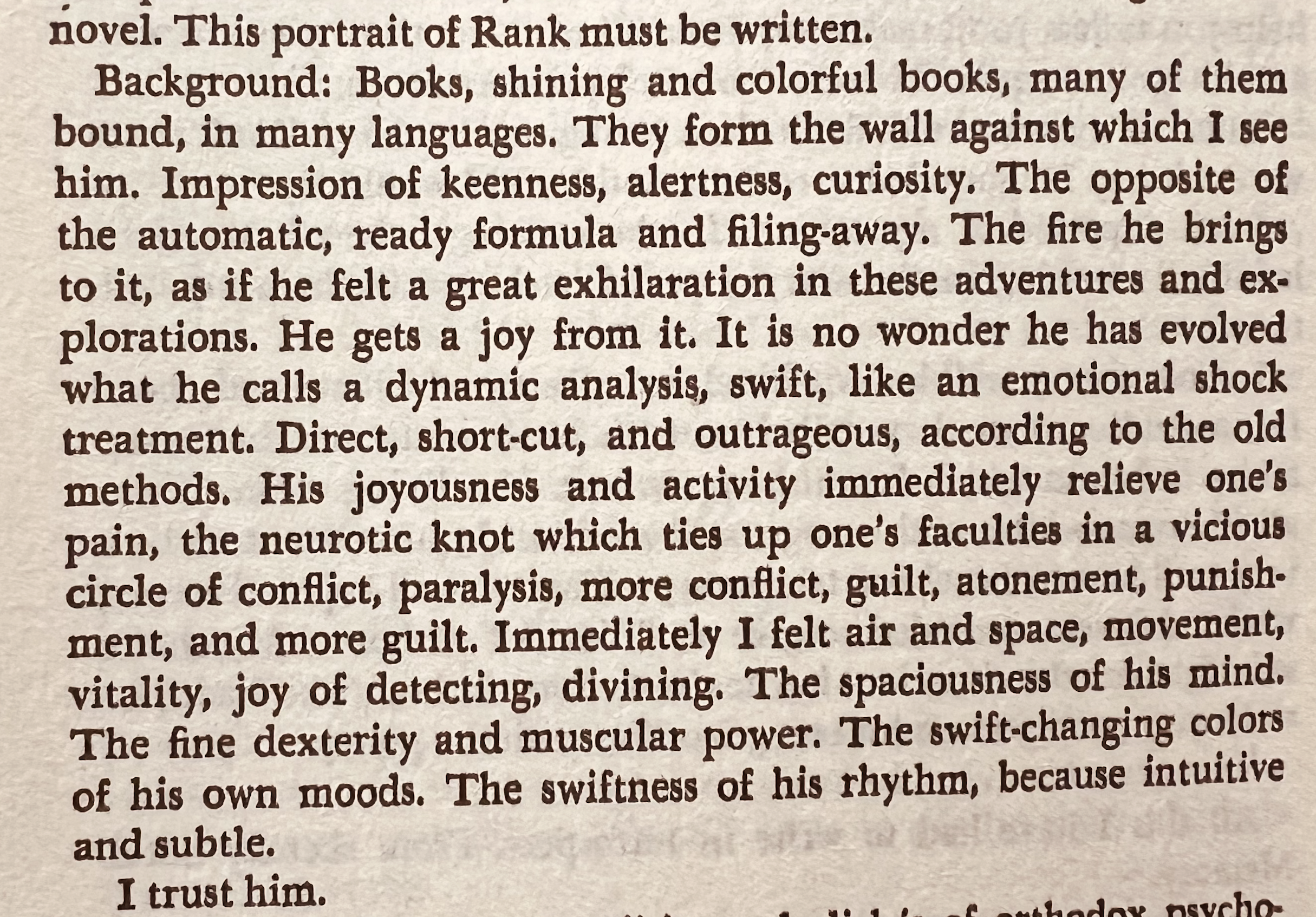
Her portraits incorporate subtle details of the environments, clothing, and mannerisms that reveal someone’s character, like this description of psychoanalyst Otto Rank from November 1933:
This portrait of Rank must be written. Background: Books, shining and colorful books, many of them bound, in many languages. They form the wall against which I see him. Impression of keenness, alertness, curiosity. The opposite of the automatic, ready formula and filing-away. The fire he brings to it, as if he felt a great exhilaration in these adventures and explorations. He gets a joy from it . . . I trust him. (Vol 1, p. 286).
To bring these portraits to life, allow changes, inconsistencies and discrepancies that expose the complexity of human nature. Seek new facets of someone’s character, new versions of their stories.
You can even incorporate exchanges, as Anaïs did:
We were drinking.
I said I thought Henry was a powerful writer.
“Let’s go and tell him that he’s great. You make me believe in him, Anaïs.”
“You want to believe. What will you live for, if you lose your faith in Henry?”
“You, Anaïs.”
“But loving me is only loving yourself. We are sisters. (Vol 1, p. 136).
Take notes on conversations for later. Include letters and messages. In a modern context, this could mean emails, text messages, or DMs. For Anaïs, these relationships were essential to her self-discovery.
2. Ask Questions (Seek Your Inner Fatality)
Curiosity fuels creativity. Questions are generative. They encourage writing to flow. They provide direction, reveal motivations.
Anaïs was interested in living an examined life, seeking what she called the “interior fatality,” hidden motivations that can block or suppress the potential of the self. Though she never practiced, Anaïs studied to be an analyst. Her natural curiosity is expressed in her constant questioning, which conveyed her ambivalences, uncertainties, the deep complexity of her nature, and the continuity of life.
Of her relationship with Henry Miller and June, she asked many questions. In October 1932, she asked herself:
What is the fever between us which clarity does not dispel? They are clearer to themselves and to each other. And I? I may suffer from the insanities they left behind. I may pick up their tangles, their insincerities, their complexities….Who is the liar? Who is the human being? Who is the cleverest? Who is the strongest? Who is the least selfish? The most devoted? Or are all these elements mixed in each one of us? (Vol 1, pp. 134-135)
Ask questions in your journal, and see what arises, even if there are no direct answers.
3. Obey the Impulse
Anaïs Nin’s diaries are marked by their spontaneity, improvisation, and free associations. She moves with fluidity from a recollection of her day, to memories, to dreams. From observation to observation. From the outer world to the psychological.
Prioritizing the inner world and having faith in your instincts can be a way of side-stepping the natural self-consciousness that arises when sitting down to write. Start with a description or observation, then follow wherever it goes. Don’t worry about formality, consistency, or making sense. The diary is a safe space to follow your whims, even if ideas seem disconnected. Trust your impulses.
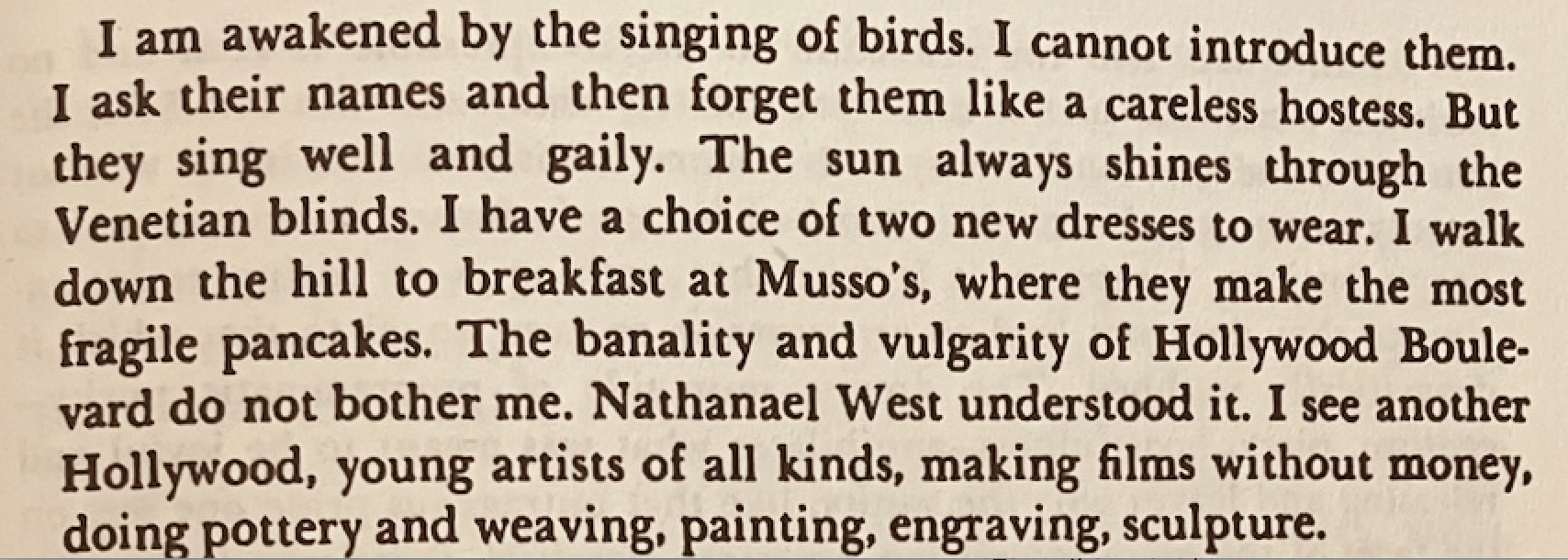
In Summer 1948, Anais wrote:
I am awakened by the singing of birds. I cannot introduce them. I ask their names and then forget them like a careless hostess. But they sing well and gaily. The sun always shines through the Venetian blinds. I have a choice of two new dresses to wear. I walk down the hill to breakfast at Musso’s, where they make the most fragile pancakes. (Vol 5, p. 35)
Where do the words and images want to flow? Allow the natural alignment between thoughts and memories, dreams and fantasies to develop.
4. Write about Writing
Reflecting on the writing process itself can be a way of clarifying your goals and assessing your values. Why do you write? What do you hope to accomplish and communicate with your writing (whether for you or the public)?
Anaïs wanted to elicit the lived experience, to intoxicate readers with the thrill of being alive. In Winter 1931-1932, she wrote:
Ordinary life does not interest me. I seek only the high moments. I am in accord with the surrealists, searching for the marvelous. I want to be a writer who reminds others that these moments exist; I want to prove that there is infinite space, infinite meaning, infinite dimension. (Vol 1, p. 5).
You might also explore the pragmatic elements of writing, even the materials you’re using. In an entry from Summer 1937, Anaïs wrote:
This volume of the diary [No. 54] is large. A large, honest, expansive one given to me by Henry, on which I can spread out beyond the diary, encompassing more, transcending myself. The small notebook I could slip into my pocket was mine, this one I cannot clutch, hide, restrain or retain. It spreads. It asserts itself. It lies on my desk like a real manuscript. It is a large canvas. No marginal writing done delicately, unobtrusively, but work, assertion.
Re-dedicate yourself to the practice by evaluating your practice. Questioning your practice and your desires allows the writing to deepen, develop, and grow. When your writing is in harmony with your artistic values, it becomes something to be treasured.
Anaïs wrote:
That is my essential reason for writing, not for fame, not to be celebrated after death, but to heighten and create life all around me. I cannot go into life without my books. They are my passports, my rudder, my map, my ticket. I also write because when I am writing I reach the high moment of fusion sought by the mystics, the poets, the lovers, a sense of communion with the universe. (Vol 3, p. 174)
Anaïs Nin
Anaïs Nin was a passionate and dedicated writer. Her diaries informed and inspired her fiction, both a record of her experiences and a way of note-taking. She wrote, “I write my stories in the morning, my diary at night.” (Vol 3, p. 173). In 1968, she wrote The Novel of the Future to explain her writing style, a mélange of interior and external life, of the real and imagined.
The Diaries show deep reflection and thoughtfulness, a tremendous love for being alive. In a speech she gave at Philadelphia College of Art, where she received an honorary doctorate, Nin said:
“Even beginning a diary, you see, was already conceding that life would be bearable if you looked at it as an adventure and a tale. I was telling myself the story of a life, and this transmutes into an adventure the things that can shatter you.”
~
Written by Zoe Marzo.
Cover image by Hungarian-French photographer Brassaï, 1932.